Lucrezia Borgia – The Life of a Pope's Daughter in der Renaissance
with family trees and 78 figures (37 of which are in colour)
at amazon.com for US$ 10.86
at amazon.co.uk for £ 7.20


"... Isabella d'Este's agent reported to her that Lucrezia [Borgia] was "full of charm and grace", and one of Isabella's ladies-in-waiting, too, grudgingly admitted that if Lucrezia "is not noticeably beautiful, she stands out thanks to the sweetness of her expression." A chronicler in Ferrara reported, "She is full of tact, prudent, intelligent, animated, pleasing, very amiable ... Her quick mind makes her eyes sparkle." (in: Sharon L. Jansen, The Monstrous Regiment of Women – Female Rulers in early modern Europe, New York and Hampshire 2002, p. 165)


surrounded by her daughter Leonora (who wears her colours Green, Red and Yellow), her husband Alfonso I. d'Este as Vertumnus in his disguise of an old woman, and her son Francesco as Pan – Lucrezia's and Alfonso's five children, the daughter Leonora and the four sons Ercole II., Ippolito, Alessandro and Francesco, can be seen as little angels in the sky and in the left background you can take a look at Ferrara.


Leonardo da Vinci who created this portrait drawing, shows her with her typical characteristics, her golden hair and her favourite pearl necklace. However, art historians from the Pinacoteca Ambrosiana in Milan, where this drawing is located, believe this is showing a portrait of the Milanese Duchess Isabella of Aragon, although all contemporary sources describe her as a "dark-haired southern beauty".
Lately I've received some requests especially from my English-speaking readers about this drawing, because according to the art historians Leonardo da Vinci supposedly drew and painted only with his left hand. Therefore I added extracts of my following response here: "Dear Mr. ... We have this very important contemporary source of a person, Antonio de Beatis, who actually visited Leonardo da Vinci in Amboise in October 1517. According to Antonio de Beatis, Leonardo had a stroke (or a heart attack) and could not use his RIGHT hand any longer. Therefore he was not able to paint any longer. Antonio de Beatis [on the 10th October 1517]: "Our master [the Cardinal Luigi of Aragon] went with the rest of us to one of the suburbs to see Messer Leonardo Vinci of Florence, an old man of more than seventy, the most outstanding painter of our day. He showed the Cardinal three pictures, one of a certain Florentine woman portrayed from life at the request of the late Magnificent Giuliano de' Medici, another of the young St. John the Baptist as a young man, and one of the Madonna and Child set in the lap of St. Anne. All three works are quite perfect, though nothing good can now be expected from his brush as he suffers from paralysis in the right hand. He has successfully trained a Milanese pupil who works extremely well. And although Messer Leonardo cannot colour with his former softness, yet he can still draw and teach." (in: The Travel Journal of Antonio de Beatis – Germany, Switzerland, the Low Countries, France and Italy, 1517-1518. Translated from the Italian by J.R. Hale and J.M.A. Lindon. Edited by J.R. Hale. London 1979, p. 132) ...
Leonardo was a born left-hander. But in the Middle Ages and Renaissance everybody born into a family (as opposed to being left on their own) was trained to use the right hand. The left hand was considered "the bad hand". This was still tradition even until the mid-20th century. None of my friends at school were allowed to write with their left hands. Like every person who was or is born left-handed, but was forced to write with their right hand, Leonardo da Vinci was very good in mirror-writing. The studies of Johanna Barbara Sattler about mirror-writing have shown that right-handed persons have, like left-handed persons, great problems to learn the mirror-writing, but left-handed persons who were forced to write with the right hand learn it easily. ... Leonardo could use both his hands because he was trained to paint with the right hand under his master Andrea del Verrocchio. Therefore when he had his stroke (or heart attack) he was unable to produce paintings like he did before. So he stopped doing it. After all he was a perfectionist. ...
Leonardo da Vinci used in his works both hands. Yet art historians tell us that he used only his left hand, even though there is no contemporary historical source supporting their claim. Therefore all works in which Leonardo used his right hand are now according to the art historians identified as works mostly of his student Giovanni Antonio Boltraffio, although we have NOT one signed work of him. This portrait of Lucrezia Borgia was made by Leonardo da Vinci, who was sent as the envoy of Isabella of Aragon ("Mona Lisa") to the wedding of her half-brother Alfonso and his bride Lucrezia Borgia to Rome in 1498. I do not think that Isabella of Aragon sent Leonardo's student Giovanni Antonio Boltraffio as her envoy to Rome. The Borgias were too important as allies for Isabella to send Boltraffio to them. The envoy had to be her best friend [and at that time already secret second husband], Leonardo."
PS: Lucrezia Borgia seemed to be dressed almost identically at her third and her fourth marriage. Leonardo da Vinci, the envoy of Isabella of Aragon, made the above drawing of her at her third marriage with Alfonso of Aragon on 21st July 1498. Already on 28th December 1501 she was married per procura, which means with the help of a proxy, to Alfonso d'Este. Regarding this marriage we find the following description about her: „Die bezaubernde Tochter Alexanders [Lucrezia Borgia] erschien in einem goldbrokatenen Gewande, dessen Schleppe junge Ehrendamen trugen, gefolgt von 50 edlen Römerinnen. Ihr goldfarbenes, über die Schulter herabwallendes Haar umschlang nur ein dünnes Band von schwarzer Seide; ihren Hals eine Perlenschnur.“ (= The charming daughter of Alexander [Lucrezia Borgia] appeared in a dress made of gold brocade, whose train was carried by young maids of honour, who were followed by 50 noble Roman ladies. Her gold-coloured hair, flowing down over the shoulders, was embraced by a thin ribbon of black silk; her neck by a string of pearls.) (in: Ferdinand Gregorovius: Geschichte der Stadt Rom im Mittelalter, Vom V. bis zum XVI. Jahrhundert, Band 7, Stuttgart und Berlin 19226, S. 451). Please, compare this description with the drawing above.

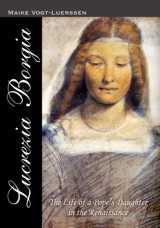
Lucrezia Borgia – The Life of a Pope's Daughter in der Renaissance
with family trees and 78 figures (37 of which are in colour)
at amazon.com for US$ 10.86
at amazon.co.uk for £ 7.20